
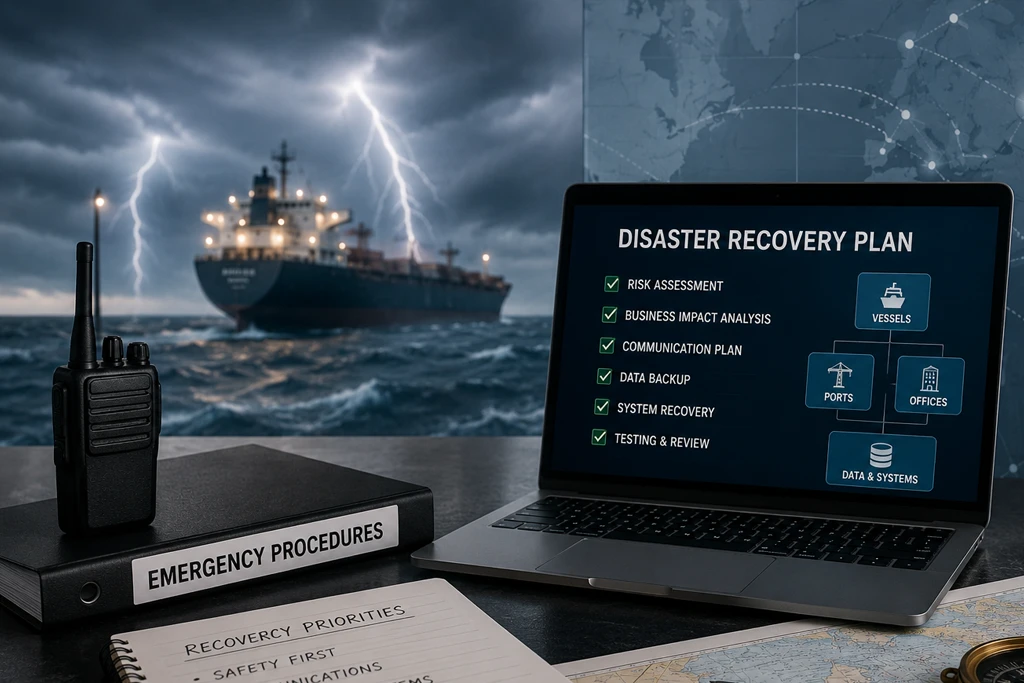
What Should Be Included in a Maritime IT Disaster-Recovery Plan?
A Maritime IT disaster-recovery plan should identify which vessel, port, and shore-based systems must be restored first, how the company will communicate during an outage, and what crews can do when shore-based technology is unavailable. It should address more than conventional file backups because maritime operations depend on communication links, vessel equipment, cloud services, port systems, operational technology, and information that may be spread across multiple locations.
A shipping company can lose access to critical systems because of ransomware, equipment failure, satellite outages, damaged cables, power problems, severe weather, flooding, fire, theft, or a failure at a shore office or data center.
The plan must assume that an incident may affect the corporate office and vessels differently. Shore personnel may lose access to dispatch or accounting systems while vessels remain connected. A vessel may lose communications while the office continues operating normally. A hurricane or regional outage may affect vessels, terminals, offices, cellular networks, and internet providers at the same time.
Recovery planning must reflect these maritime-specific combinations.
Begin with the Systems Required to Operate
The first step is to identify which systems the company needs to continue safe and lawful operations.
A maritime company may depend on vessel communications, dispatch platforms, crew-management systems, maintenance records, customer documentation, cargo information, electronic forms, accounting systems, regulatory records, and remote equipment-monitoring tools.
Aboard the vessel, important technology may include bridge workstations, electronic charts, satellite and cellular equipment, onboard servers, machinery-monitoring systems, cargo systems, security cameras, and computers used for required reports.
Not all of those systems should receive the same recovery priority. The company needs to determine what must be restored within minutes, what can wait several hours, and what can remain unavailable for a day or longer.
That decision should be based on operational impact rather than convenience. A system used to send required arrival information may deserve a higher priority than a large archive of old office files.
Recovery Plans Must Separate IT from Operational Technology
Information technology and operational technology often share connections aboard a vessel, but they do not have identical recovery procedures.
A damaged office computer can often be replaced, joined to the network, and restored from a standard backup. A failed navigation, machinery-monitoring, dynamic-positioning, or cargo-control system may require manufacturer involvement, specialized configuration, calibration, certification, or testing before it can return to service.
NIST’s guidance for operational technology emphasizes that incident response and recovery must consider safety, reliability, environmental impact, and the need to test recovery plans.
A maritime recovery plan should therefore identify which systems the company’s IT provider can restore, which require an equipment vendor, and which require approval from vessel-management or safety personnel before changes are made.
It should also document the correct order of restoration. Reconnecting systems too quickly after an incident can reintroduce malware or place unverified equipment back into an operational environment.
Backups Must Exist in More Than One Place
Maritime companies frequently store information across office servers, cloud applications, laptops, vessel computers, and specialized vendor systems.
The recovery plan should identify where each type of information is stored and whether it is included in a backup.
A file located only on a vessel computer is not protected simply because the company backs up its shore office. A cloud application is not automatically protected from accidental deletion, compromised accounts, malicious changes, or a failure affecting the application provider.
Important data should be backed up using more than one method or location. At least one backup should be protected from direct modification by the same accounts and systems used in daily operations.
Offline or immutable backups can reduce the chance that ransomware will encrypt both the production data and the recovery copy.
The company should also establish recovery-point objectives. That means deciding how much recent data it can afford to lose. For some records, a backup from the previous night may be sufficient. For dispatch, vessel status, or operational reporting, losing an entire day of information may be unacceptable.
Vessel Data Requires Special Planning
Backing up data from vessels can be difficult because connectivity may be limited, expensive, or intermittent.
A continuous cloud backup may work while the vessel has a strong connection but interfere with operational traffic when the vessel moves to a constrained satellite link.
The backup system should therefore be aware of connection type, bandwidth availability, and data priority. Large backups may need to occur while the vessel is at port, within cellular coverage, or connected to a higher-capacity satellite service.
The vessel may also need a local backup that remains available when internet access is lost. However, a backup stored on the same computer or in the same equipment cabinet may not survive fire, flooding, electrical damage, or ransomware.
The company should determine which vessel records must remain available locally, which should be synchronized ashore, and how long the vessel can operate without access to its shore-based systems.
Plan for the Loss of Vessel-to-Shore Communications
A maritime recovery plan must include procedures for a complete communications outage.
The crew should know how to determine whether the problem involves the primary satellite service, the backup connection, onboard networking equipment, power, or an external outage.
The vessel should have offline copies of important contact information, escalation procedures, and any documents required to continue operating safely.
The company should also determine what information must be sent once communications are restored. Notes made during the outage may need to be entered into dispatch, maintenance, compliance, or customer systems later.
Where multiple communication services are available, the recovery plan should define which traffic receives priority. Operational messages may need to move to a lower-bandwidth backup connection while cloud synchronization, entertainment, and routine updates are suspended.
Current maritime connectivity offerings increasingly combine multiple satellite or cellular paths, but hybrid connectivity is most effective when failover and traffic priorities have been configured before an outage.
Shore-Based Recovery Must Account for Active Vessels
A shore-office outage does not stop vessels from operating.
Crews may continue producing reports, maintenance records, time entries, cargo information, and operational updates while the office cannot receive or process them.
The disaster-recovery plan should define how those records will be stored temporarily and synchronized once shore systems return.
Vessels also need an alternate way to contact the company if the primary office telephone, email, or dispatch system becomes unavailable. Important contact information should not depend entirely on one cloud account or one company phone system.
A secondary location, emergency number, alternate email domain, or predefined communication chain may be necessary.
The plan should identify who has authority to make operational decisions when normal systems are unavailable. IT recovery and operational command are related, but they are not the same function.
Spare Equipment Should Be Prepared Before It Is Needed
Maritime recovery may require replacement hardware that cannot be purchased and installed quickly once a vessel has departed.
Companies should identify equipment that is both critical and likely to fail, such as routers, switches, wireless access points, power supplies, cellular modems, computers, drives, and specialized cables.
Suitable spares can be stored at the office, a port location, or aboard certain vessels. Wherever possible, the equipment should be preconfigured and labeled for a specific use.
A replacement firewall that arrives with factory settings may still require hours of configuration. A preconfigured device can often be installed by a crew member or local technician under remote guidance.
The plan should also include vendor contact details, model numbers, serial numbers, warranty information, configuration backups, licensing details, and installation instructions.
Test Recovery Instead of Assuming It Works
A backup is not useful until the company confirms that the data can be restored.
Recovery tests should include both technical restoration and operational decision-making. The company might simulate ransomware at the shore office, loss of a vessel router, failure of the primary satellite service, or the unavailability of a critical cloud application.
The exercise should determine whether employees know whom to contact, whether the required documentation is available offline, whether vendors respond as expected, and whether replacement equipment can be installed.
NIST guidance recommends testing operational-technology incident-response and recovery plans at intervals appropriate to the organization.
For regulated maritime companies, exercises can also support broader cybersecurity-planning and training obligations. The Coast Guard’s current cybersecurity framework emphasizes documented planning, assigned responsibilities, training, reporting, and preparation for incidents affecting vessels and facilities.
Recovery Must Include Validation
Restoring a system does not automatically mean it is safe to use.
After a cybersecurity incident, restored devices should be checked for malicious software, unauthorized accounts, altered configurations, missing patches, and evidence that the original vulnerability remains.
Operational systems may require additional testing to confirm that sensor readings, timing, interfaces, alarms, and connected equipment are functioning correctly.
This is particularly important for systems that use positioning, navigation, and timing data. NIST’s 2026 draft guidance for PNT resilience includes recovery actions such as restoration, recalibration, resetting, and test validation of equipment.
The company should document who is authorized to declare each system ready for service. An IT technician may confirm that a computer starts and connects to the network, while a vessel officer or equipment vendor may need to confirm that the operational application is working correctly.
How ComSolutions Helps Maritime Companies Prepare for Disruptions
ComSolutions helps maritime companies develop disaster-recovery plans that reflect the way vessels, ports, and shore offices actually operate.
That may include identifying critical systems, designing vessel and office backups, protecting recovery copies, documenting network configurations, preparing spare equipment, testing failover connections, and coordinating with maritime equipment vendors.
We also help companies establish recovery priorities so limited time and connectivity are used to restore the systems that matter most.
A Maritime IT recovery plan should not begin after a vessel loses communications or ransomware reaches the shore office. It should already explain what the crew, office personnel, vendors, and IT provider will do next.
To review your current backups and recovery process, contact ComSolutions to schedule a Maritime IT disaster-recovery assessment.